
Driven by a sense of adventure, Jose Carlos Pereira arrived in Macau over 30 years ago, to work and to visit places that as a child had fired his imagination. It was the beginning of a love affair with Asia that would lead to an extraordinary collection of beautiful and priceless antiques.
When on the train from Sintra to Lisbon, clinical laboratory scientist Dr Jose Carlos Pereira bumped into an old colleague who told him she’d moved with her husband to Macau. Their conversation piqued his interest. Would he like to go to Macau she asked. Yes! Well, send me your CV. This was back in mid-1994 when at the time there were only 2 pathologists in our public hospital Conde de Sao Januario.
Excited and full of anticipation, Jose confesses that he was at first underwhelmed when he arrived. “Macau’s weather in September can be very cloudy and I’m used to the sunshine and cobalt blue skies of Portugal. Everywhere was grey, the water was brown, and the caged balconies … it was a culture shock. I knew no one, my friend who’d initially invited me over was traveling, so for the first 15 days I found it lonely.” Gradually Jose began meeting friends of friends from back home and people he’d meet at musical evenings and at art exhibitions. He would join them for dinner afterwards and soon become part of a good social group and start planning early on to join others on a first Asian adventure out of Macau – to Burma!

For the first four weeks Jose stayed in the Beverly Hotel, which is within a 15-minutes’ walk to the hospital so he could be on call for any emergencies.
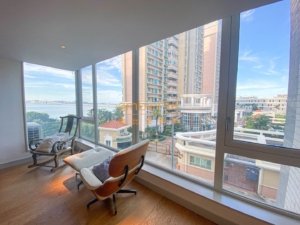
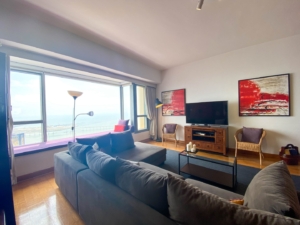
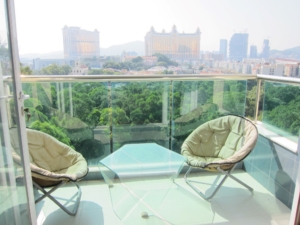
Eventually he was convinced by a landscape architect friend to move to up-and-coming to Taipa where he secured an apartment in Hoi Yi Fa Yuen. “At the time it had wonderful sea views of the outer harbour, the city scape, the night time neons of the Macau skyline.” And then, to the side, Nova City began emerging. Time to move on; and after 2 years Jose returned to Portugal where he stayed for the next 6 years, working in Faro, Caldas da Rainha and Lisbon.
Then in 2002 Jose was invited again to help cover staff shortages in the laboratories of Sao Januario: 3 colleagues were going on maternity leave so Jose soon found himself on his way back to Macau to provide cover – a year at most he was told, during which time he could also explore a little bit more of Asia. Like many from overseas who come to Macau for work this short-term mission turned into 2 years – and eventually into 20 years!
So he packed up and headed back; “I arrived on the 3 January 2003”. Thus began Jose’s next Macau chapter, a series of “twenty times, 1-year contracts!” he laughs.


Both sets of Jose’s grandparents moved from Portugal to Angola, Africa in the early 1900’s “looking for a better life in the Colonies.” His father was born and raised in Africa where he became an industrial designer for the CFB railway company and met his mother who was an accountant. They went on to have Jose and his younger siblings all born in Lobito, Angola. Tragedy struck in 1971 when at 11 years old Jose’s father died. For his mother, personally, emotionally and financially it was a very traumatic situation for the young widow, with 3 sons and a fourth on the way, and with no immediate family support system nearby. As the 1975 civil war in the area caused further hardship, she moved to the capital, Luanda, and spent 15 more years working to continue earning money to support the family and to see Jose through his university medical studies where he specialized in clinical pathology.

The family eventually settled back in Portugal, in the charming resort town of Sintra.

From a young age Jose had collected stamps and coins; as a boy visiting his grandparents he recalls discovering some coins in an old sewing machine drawer. Old coins, some 60 to 80 years old by then, some from the late monarchy and from the first Republic of Portugal, others from the Belgian Congo coming from his grandfather’s job as he had traveled the train line through all Angola to the Belgium Congo borders. They inspired Jose’s imagination of stories from magical far-flung places. Now based in Asia his interest in collecting began in earnest. Days off were spent rummaging through the little dusty ‘holes in the wall’ shops of old Macau and Hong Kong, hunting down treasures.
“I’ve always been a collector at heart – when I travel, I like going to the markets. At the beginning I started with little knowledge and I didn’t have any particular objective for collecting, I would just buy what I liked or triggered attention.
One day, some 13 or 14 years ago, I was strolling around the narrow lanes of old Macau with a German friend who could speak Cantonese. I spotted a duck – porcelain, with chips and legs broken and glued back, but with a seal on its underneath. The seller wanted MOP 1,000 – my friend thought I was mad to even consider buying such a chipped, cracked piece. I left the duck and over the next 3 or 4 years I’d often pass the shop and look in to see it sitting on the top shelf, continuing to gather dust. As time passed the duck remained on my mind. I pursued my interest in antiques and occasionally would buy a book or two from the Museum gift shop each time I visited an exhibition at the Cultural Centre. Browsing one day, I turned the page and there was my duck, exactly, and described as a Ming incense burner. I rushed over to buy the duck …. but the shop owner wasn’t selling – others had been asking about it too.” It took Jose another two years to convince the owner to sell – and in the end he bought it for … MOP 2,000!

The duck became Jose’s mascot and marked the start of a more systematic and knowledgeable approach to collecting and to negotiating. “I cannot fix the money but I can fix ignorance”; he started studying, reading voraciously on Chinese history, ceramics, symbolism, styles – “it’s all related to art, religion and culture, all linked with history” – and making conscious purchases to add to his collection. As his knowledge increased and his tastes refined, Jose started visiting the antique shops that line the streets by St. Paul’s façade and the whole Chinese bazar, learning and buying from the antique dealers, several of whom over the years have become close friends. “They helped educate my eyes”, he explains, “it was an epiphany, something new started in my life”, a real passion and appreciation for the beauties of Asian art.
“My collecting now is driven by intuition. A combination of educated eyes, experience, knowledge, and …luck ! I’ve reached the level where I can follow my intuition. The reality, genuineness, the honesty is in the piece. Quality has a voice and doesn’t cheat you. I’ve learned how to separate the wheat from the chaff.”
While Jose’s primary focus is on Chinese ceramics, terracotta, porcelain, stoneware, “All arts of fire”, he also owns a fine collection of classical Chinese paintings, rugs from China, Khotan in Xinjiang, northwest China and Ningxia, northcentral China, Tibet, Beijing and central Asia. And Southeast Asian textiles and carvings, many from Ubud, Bali. “I’m not very knowledgeable about Indonesian crafts; when I’m on my travels I buy what I like, what I can afford, and what I can carry! The furniture that I’ve bought, the various Chinese cabinets for example, were due to circumstances and opportunity, I happen to be somewhere, I liked what I saw so I bought them.” “Lately I’ve been buying jade accessories and amulets from several periods of Chinese history”

It’s all very much related to the people I meet. I don’t buy from auctions – it’s too sterile for me, sitting at my desk, pouring over my computer.” He enjoys the social interaction with dealers, yet he buys alone, savoring in the buzz and excitement of unearthing treasures. “I won’t have people tagging along with me … a tiger hunts alone!” he laughs.
“I look for the unique, things with bizarre singularity” he says, holding up a large decorative jade chop. “And for the Chinese, items tend not to be simply decorative but they have more of a metaphysical, mystic or mythical element – made to help the dead in their afterlife or as auspicious gifts, for example. Over the years I’ve self-educated through catalogues, blogs, books, exhibitions and through friends, friends like Mae Ho, whose shop is near St. Antonio’s church, through my friendship with her I’ve learned so much, especially about pieces from the Classic era of China. I’ve learned about the famous kilns around different parts of China, about the different materials used by the craftsmen. The chemistry and physics of how ceramics ingredients are mixed and fired and their final reactions are familiar to me due to my line of work”, he explains.
“I’ve never counted my pieces but certainly we’re now into the thousands. Does he keep an inventory? Yes, and this is divided into months and years. Much of his collection is now in Portugal; “I’ve made several shipments back to Portugal over the years.”

And what about sharing his collection with others? Should some of the pieces perhaps be in a Museum to be enjoyed by many? Jose bought a shop in Sintra, a while back, originally for his younger brother to have an office there, but as that didn’t happen, he now plans to use it to display some of his treasures and set up a club of friends and other likeminded people interested in Asian arts and antiques, to gather over coffee or drinks, and to share his wonderful finds. “An atmosphere much like Macau Soul here in Macau – relaxed, friendly”, he smiles.
And once retirement comes around, what’s the plan then? “I still want to travel, to know Europe better, whilst I have the stamina and the will. And eventually I will spend some time in Asia. Ubud, in Bali, is my favorite place in Asia – so perhaps I will spend 3 months of the year there.” Just like Chatuchak weekend market in Bangkok, Ubud is an artistic hub. Artists from around the world have been drawn to the creative energy there since the late 19 century, making their own schools and leaving an imprint on the local artistic scene. Locals took some of this ‘flavor’ and mixed it with their own traditional crafts to what is now a blend of exotic Australasian with Western-influences. Merchants from far and wide take their wares to Bali for the tourists: paintings, textiles, carvings, so it’s a great place for a keen collector!

And Macau, what does Jose like about living here? “It’s a convenient town to get around and I really enjoy my job and my colleagues. It’s an ideal location for traveling and exploring other corners of Asia. I came here initially because I was driven by adventure and exotics. I wanted to visit places, to know different cultures. My friends and family were enthusiastic – go, take a look, Macau is close to Japan, Southeast Asia, Indonesia, Australia… My mind was full of imagination. As a child, my father would show me his world globe, I’d read books about the world, I became familiar with these places although they were very distant from my home.” Through the years, that distance is no longer; Macau (and Asia) has become as much a sense of home as his roots in Portugal.
Article by Suzanne Watkinson of Ambiente Macau, for the July-August edition of Macau Closer magazine. Photos by Jose Carlos Pereira. .