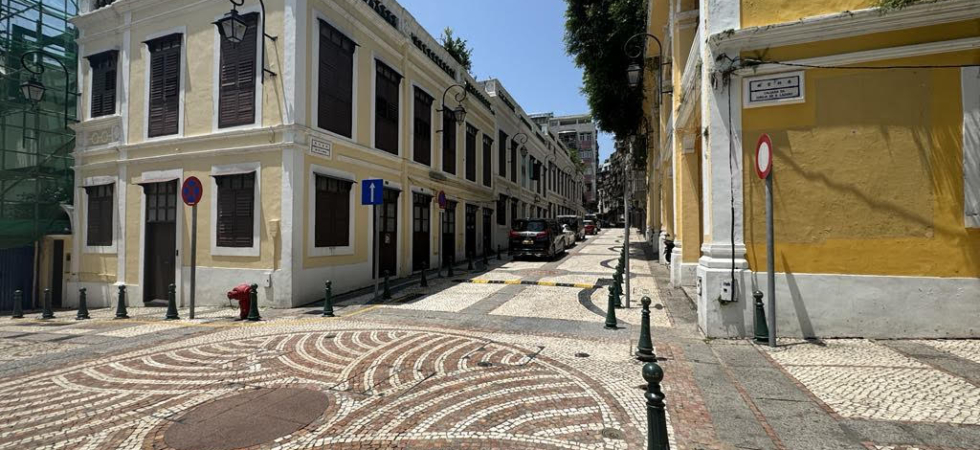
Set in Macau’s historic St. Lazarus district and tucked within a row of 2 storey wooden houses lining a narrow one-way street lies number 32 Rua de Sao Miguel. The house had fallen into disrepair; it took the foresight and passionate determination of Macau resident and entrepreneur Harry Chan and interior designer Leo Yuen to tackle a year-long renovation to bring the home back to life again.
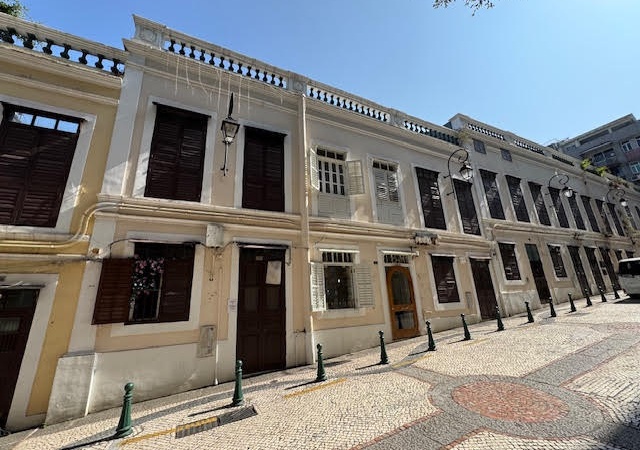
Within 50 yards of Macau’s 16th century Sao Lazaro catholic church, number 32 Rua de Sao Miguel is a building with an interesting past. Formerly a civilian residence, in the 2000s the owner emigrated overseas and sublet it to relatives and friends. Located in a government designated cultural area where demolition and reconstruction are strictly prohibited, preservation of the building became the primary leasing condition. As the years passed structural problems gradually worsened and then in September 2011 typhoon Hato ripped away roof tiles causing serious water leaks and subsiding floors. These conditions became too much for the tenants to contend with and they moved out.
This is when the St. Lazarus Parish Creative Industry group took over the property. Interior designer, Leo Yuen Wai Ip, having spent childhood years in the district, met with the group and presented a proposal that went significantly beyond a mere renovation that addressed existing issues. The result was that the-once-dangerous building was restored and revitalized into a cultural space open to the public, G32 Gallery. The restoration project was a respectful effort to maintain Macau’s past and heritage. Furnished with 1960’s decor and items the house depicted the life of a local Macanese inhabitant from that time. Leo used his deep cultural understanding of the surroundings and worked tirelessly on restoring the building’s façade and interior while preserving the original flavour. “What you need is the heart to give it a clean scrub and learn to appreciate it all over again” he explains.
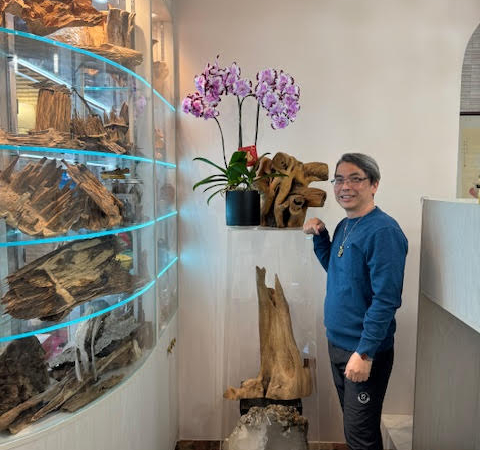

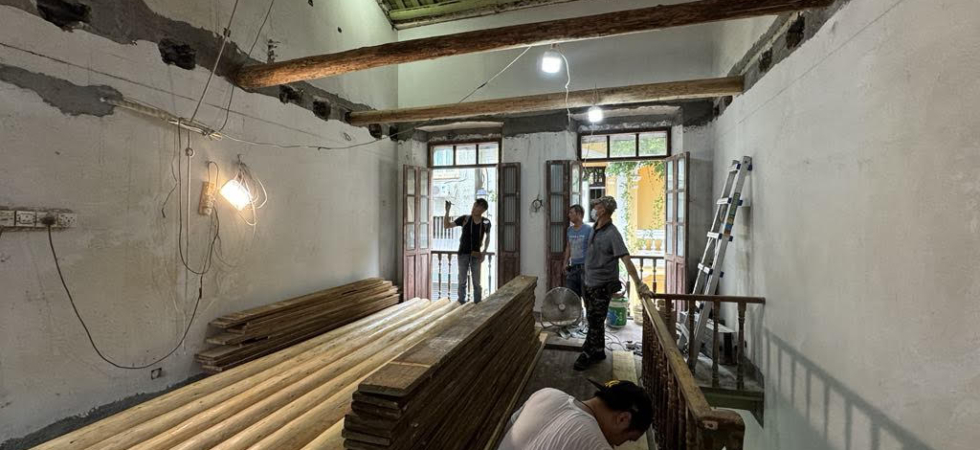
Four or so years after the building reopened, local resident and preeminent authority on crystals, Harry Chan (his name in Chinese), was invited to give a presentation in the Gallery. “I walked in and fell in love with the space and somehow knew that one day this property was destined to be mine!” More years passed and Harry frequently thought about the house and how he would love t bring it back to life. Then in 2023 a friend who knew the building owner told Harry that the owner wanted to sell. Harry jumped at the chance. “Not only for decoration, not just for my business. Each separate floor had a different function, and combined together into one live building it connected to my hart.” The purchase wasn’t easy; permission had to be given by the Cultural Department because the area is of cultural significance. No bank would give a mortgage on such an old property “so I had to pay for it fully. I used my whole life savings so I’m a poor man but my heart feels so rich!” he smiles.
And as if things were just meant to be, Harry’s longtime friend is Leo Yuen, the same interior designer who had worked on the building’s restoration a few years earlier. Engaging his services, “I had complete trust in Leo” says Harry. “We met 4 times, each time for about 3 hours, when Leo explained to me his vision of transforming the space without losing its historical essence and his idea to innovate thoughtfully, and I told him about my thoughts, my aspirations and for my passions. I never once visited during construction.” Leo adds: “yes, it’s better that Harry stayed away and let me get on with it! I was clear about the structure, about every detail of the building and the client’s ambitions – the main point was to create an interior that adds functionality across each separate floor to support a new business operation model, while inspiring a new, personalised lifestyle for Harry.” His only risk was employing a contractor that he’d not worked with before. “I had mixed feelings about this. But not every contractor wants to take on a job of this complexity and attention to detail.”
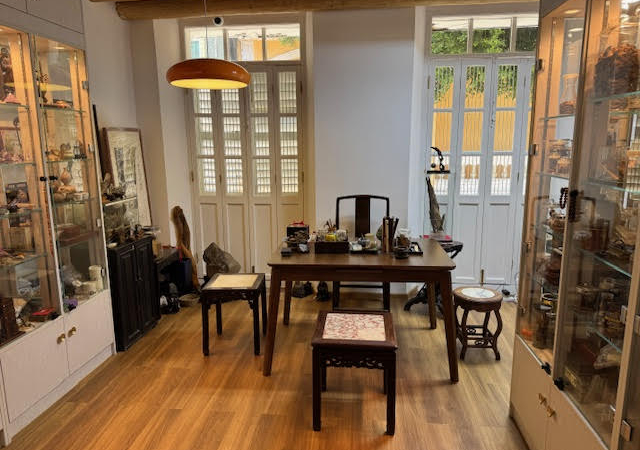
Today, beautifully restored after a year of renovation, the house is a base for Harry’s business, Chio Hei Tat Trading, from where he sells crystals, agate and incense, while also being a comfortable home.
Born in Guangdong, at 8 years old Harry moved to Macau with his parents and brother to join his grandfather who was already here running a shoe business. Harry’s father is a doctor in western medicine, who after over 45 years continues to this day to run his clinic in Macau.
“My Major at the University of Macau was in communication and marketing; after graduating my first – and last – job was for the Macau Jockey Club where I worked full time in the membership department and part time as the photo-finish judge for the races. I learned valuable skills in how to operate a clubhouse, a pro shop for the members, how to run a business, operational skills and the importance of public relations. The judging taught me to be logical and confident. After 6 years at MJC I left to follow my hobby and passions and set up my business selling crystals. My first shop, 26 years ago, is one of the oldest crystal shops in Macau. Back then there were 8 shops, now there’s only 2 of these shops that have survived, and mine is one of them.”
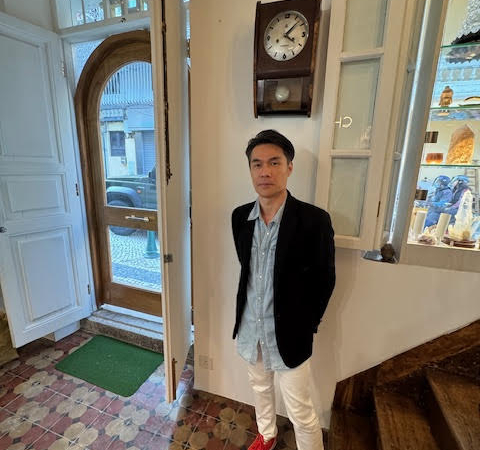
As one enters an arched doorway off the street, the visitor is welcomed with the perfumed air of incense burning. The ground floor has ceilings of over 5 meters high; this together with the scaling design and the layout solution makes the small space feel light and airy. Retaining the building’s authenticity and vintage feel the original front door was kept. Also the old floor tiles – their geometric design from the 60’s and colours muted over the years, adding to the time-gone-by atmosphere – have thankfully been preserved, painstakingly lifted so as to repair the crumbling wood floor underneath and then carefully put back. “I believe in keeping a connection with the past,” Harry explains, as he points to the midcentury wall clock hanging at the entrance and small Ching dynasty cabinet that were left by the previous inhabitants.
To the back of the ground floor, behind the display counter and wall shelves is a guest powder room and beyond, a meditation room where Harry spends at least half an hour each day in calm contemplation, connecting with nature through the circular glass ceiling panel that looks up on to a terrace above and his collection of plants and herbs. This took careful consideration of the property’s orientation to optimise the amount of natural light entering the meditation room.
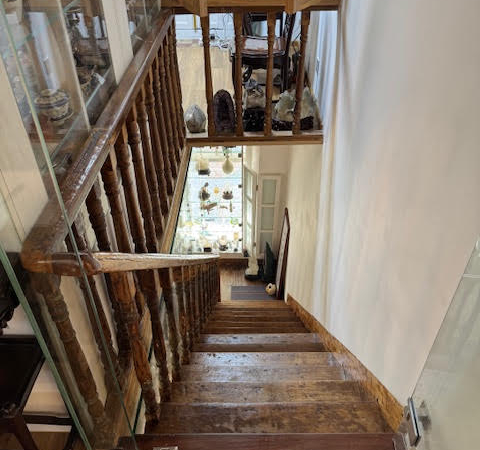
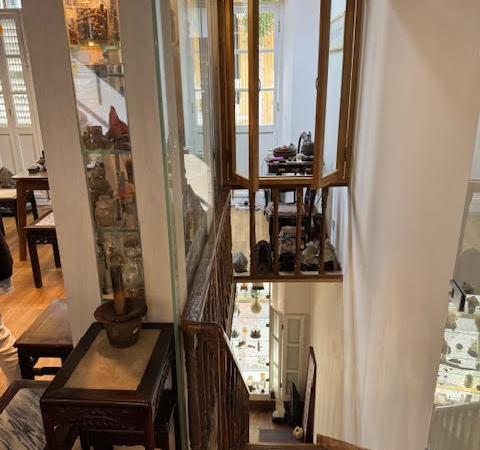
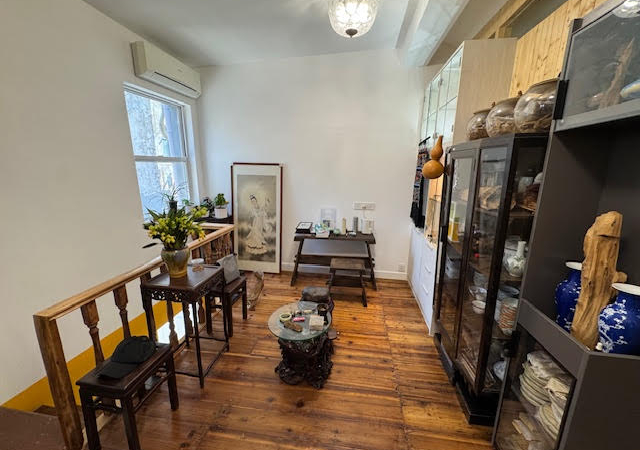
The visitor is guided up a steep vintage staircase, the wooden structure, banister and spindles all original to the house, to the first floor. Cabinets line both lengths of the main room and are filled with artefacts. The warm cabinet lighting further enhances the ambience. This is here where Harry keeps his personal collection of treasures gathered over the years. Open to close friends he will sell if the person really wants and appreciates it. “We are only caretakers of things, and besides, I’m getting old, I can’t take these with me!”
The first floor is also the registered address for the Associação da Cultura do Incenso de Macau (Macao Incense Culture Association), of which Harry is Chairman. “We currently have 154 members made up of a mix of business owners and private users.”
“I became interested in aroma culture during the SARS epidemic in the early 2000’s when I started looking into health care products. At the time I was burning incense in my shop and at home to cleanse the air … I used the traditional incense which I found had a horrible smell. So I read a lot of ancient books, I met and talked with sellers in old aroma shops in Macau, I learned many different recipes. I talked with aroma customers in neighbouring provinces in China.”
Gradually Harry created “brand Macau” aroma products, developing his own recipes for more than 15 kinds of incense tailor made for healthcare, prayer sacrifice, regulating the environment, gathering festivals, both high-end collection-level products and also for the general entry-level products. He attends fairs and exhibitions and represents Macau overseas at other business opportunities to educate and to encourage the culture of fragrance. “The association is very important to promote a professional image. I have given a series of 3-minute talks on incense culture for Macau’s TDM tv station. I go to China to run workshops, our association cooperates with other Chinese associations, we hold meetings, exhibitions.”
The first floor has an open kitchenette that leads out to a teeny terrace with a lightwell underfoot (through which the meditation room below can look up). Pots of mint, rosemary, bergamot, a lemon tree, Cau Cou (臭草)— used in a green mung bean Chinese dessert give off a gentle scent. A scissor window between the terrace and the interior enables Harry to sit outside and a friend to sit inside, both being able to chat over the open space.
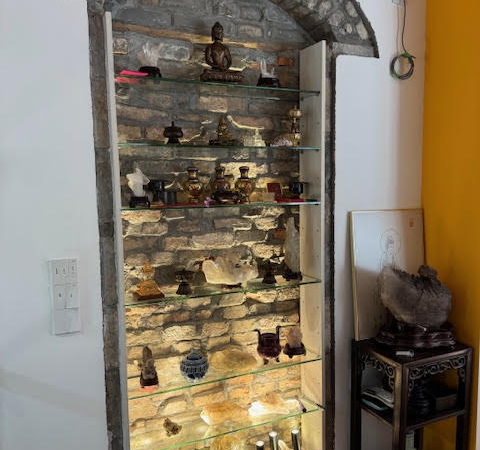
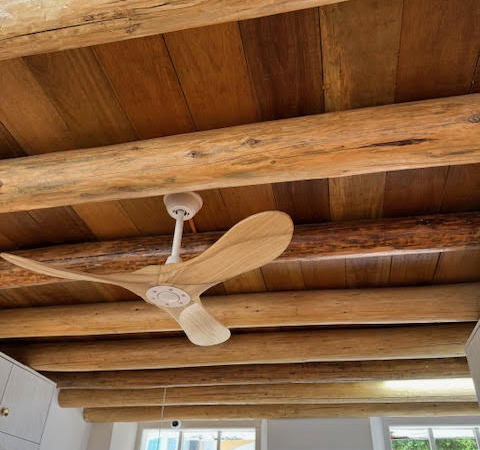
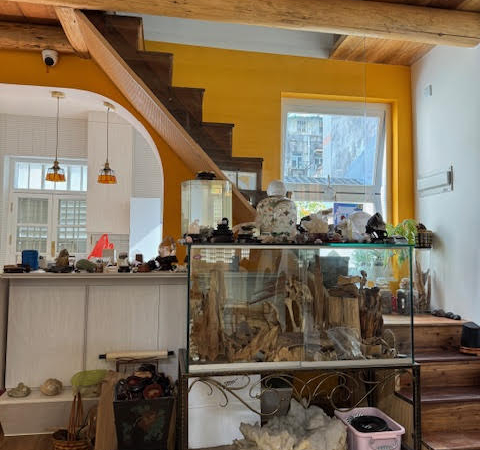
To ensure the design remains coherent, flooring on the first floor is pale engineered wood imported from Germany. The ceiling is all real wood – old stock from Malaysia with a beautiful patina. The beams, “we were able to save two originals, the others are new.” The steel framed window in the kitchen and the handmade folding doors on the windows are all original to the building. An interesting alcove, uncovered unexpectedly during construction, has been retained, lined in grey brick and serving as more shelf; it is understood to be originally a doorway to the adjacent house. A feature wall of deep ochre yellow was chosen as a cohesive reflection of the buildings opposite.
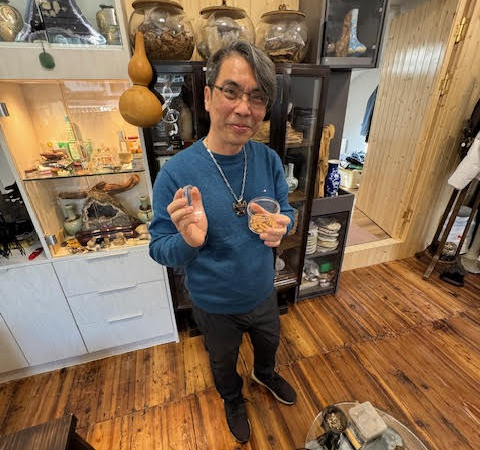
Up another flight of stairs to the second floor is a private residence consisting of a bedroom, bathroom and a main room where Harry mixes his incense ingredients; “I grind up different combinations of sandalwood, agarwood, amber rock and various other tree bark, roots and dried fruits into powders using my own recipes, combining Asian and modern materials, which I then send to a factory in China that specializes in making joss sticks.”

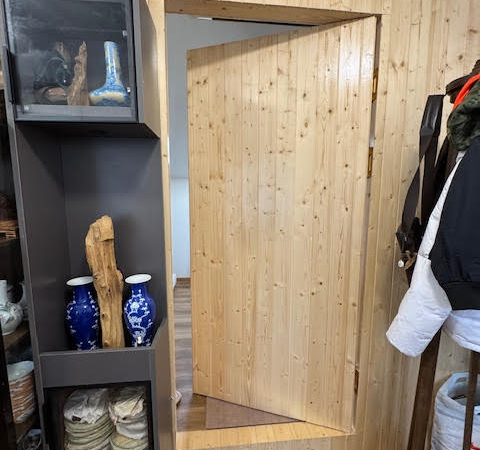
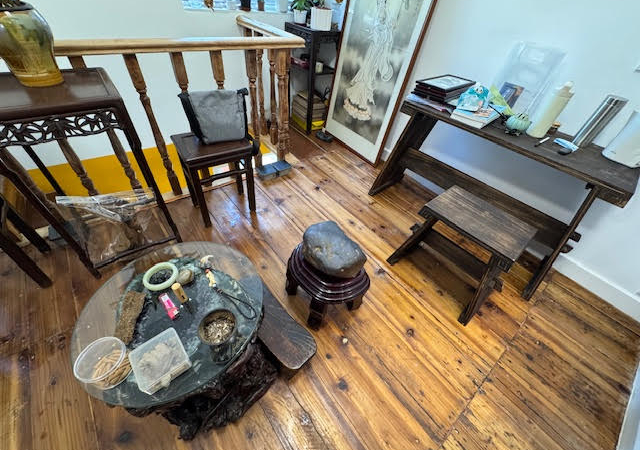
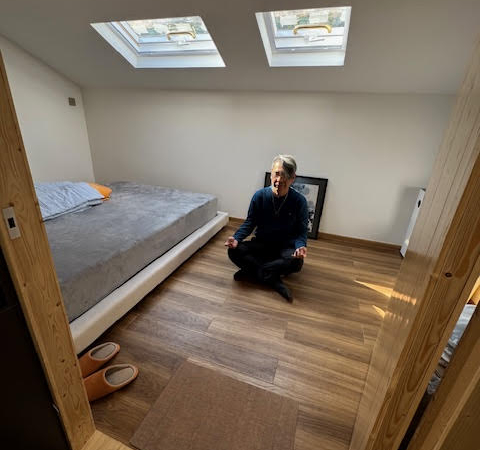
The flooring in this area is notable; during renovation the under flooring was replaced with new, thick sturdy pine and then the original old cedar wood (caam muk) with its stunning wood grain and patina, laid back on top. Standing in stark contrast is a room divider and door made of pale sauna wood. Opening to a raised platform, this is a shoes-off, intimate, inner sanctum accommodating a low bed and a meditation space. Two modern skylights introduce warm, natural light. “We used sauna wood here” explains designer Leo “as it is natural, inexpensive and being used for building saunas it’s suited for relaxation, ideal for this bedroom.” “All the walls on this level have been reinforced and waterproofed,” he adds.
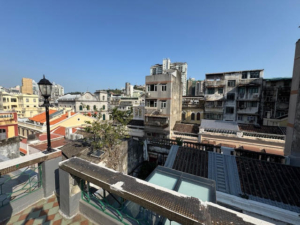
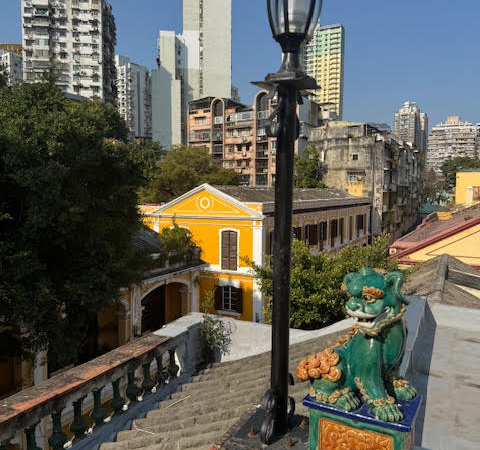
One final staircase up is the roof, space for more plants and a sitting area to enjoy the glorious 360-degree views of the St Lazaras Quarter. One of the best-preserved historical neighbourhoods in Macau, its calcada-tiled streets and little lanes reminiscent of the old central parts of Lisbon.

So now the renovation is complete and Harry has moved in, what’s the plan for the future? “I’m excited about continuing to support and foster Macau’s aroma culture, through education programmes, exhibitions and workshops. And I later plan to offer breathing and meditation courses on the first floor for our association members.”
To contact Harry Chan, message +853-6661-8669 for Chio Hei Tat Trading and the Macao Incense Culture Association. For interior designer Leo Yuen: leoyuen.mr@gmail.com
This article was written by Suzanne Watkinson, Managing Director of Ambiente Macau, for the Macau Closer magazine’s May-June 2025 edition.
Photographs by Suzanne. Photos 3 & 5 showing the property under construction, provided by interior designer Leo Yuen.